

Case Study: How One Investor Turned a Single Tiny Home Into a 5-Unit Micro-Resort
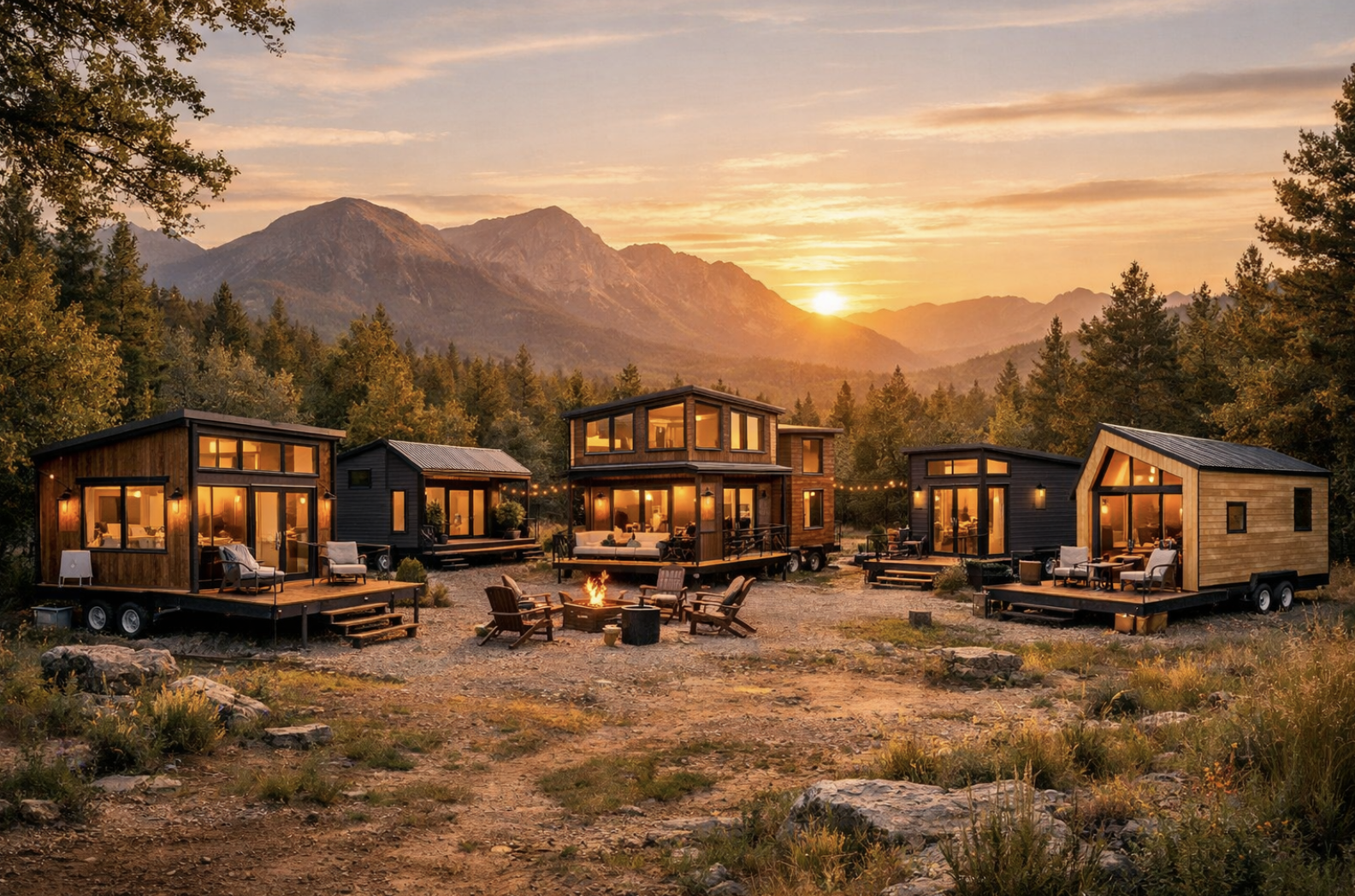
Every investment journey begins with a first decision. For Michael, a 38‑year‑old marketing executive who spent years dreaming of land ownership and passive income, that decision began on a rainy Sunday morning scrolling through listings of cabins he couldn't afford. The numbers didn’t make sense. A single traditional cabin required a minimum of $300,000 upfront and came with a nine‑month construction timeline. It was a commitment that would place him entirely at financial risk before he ever earned his first dollar.
What changed his trajectory was not a new idea, but a different scale. Instead of thinking in terms of cabins and multi‑acre developments, he asked a smaller question: “What if I just placed one?”
He found a parcel of usable land—just under three acres—outside a mid‑sized mountain town that attracted travelers year‑round. Instead of committing six figures into structures he hadn’t tested, he chose to begin with a single luxury tiny home, priced at $128,000 turnkey. Including utility trenching, permitting, a simple gravel drive, and a deck expansion, his all‑in cost reached $162,000. Unlike the cabin that would have taken most of a year, he had guests inside his first home in just under five months.
The bookings surprised him. He anticipated twenty to thirty percent occupancy in his first months. Instead, he saw sixty‑five percent almost immediately. Weekdays filled with remote workers, and weekends brought couples seeking quiet. His nightly rate began at $245. By month four, after adding a firepit area and upgrading the outdoor seating, he comfortably raised it to $295. That single unit generated just under $38,400 in its first twelve months.
But what made expansion possible was not the revenue—it was the clarity. With only one unit, he was able to learn operations without stress. He solved check‑in flow. He tested cleaning turnover schedules. He learned which amenities mattered enough to influence rates. The outdoor hot tub he added later cost $7,800, but it increased weekend pricing by $75 per night and lifted annual revenue by nearly $11,000. The math made the decision obvious.
The second home arrived the following spring. The cost was nearly identical to the first. This time, setup took less time because utilities were already present. By the end of that year, two units generated over $78,000 combined. His mortgage—previously unthinkable at cabin scale—now felt covered by a single property.
Scaling from two to three was when the “single home rental” quietly transformed into something else. Guests began identifying the property as a destination. Reviews mentioned “the tiny home retreat.” One couple booked out the entire weekend and asked if he could accommodate group retreats. Without meaning to, Michael had created a brand.
At three units, he began to understand the power of economy of scale. His cleaning contractor offered a reduced rate per turn‑over if multiple units were serviced at once. He negotiated wholesale rates for consumables. The land no longer held homes—it held a vision.
By the time he added a fourth and fifth unit, something remarkable happened: his nightly rate increased without changing amenities. Perception had shifted. Guests saw value in staying at a curated environment rather than a one‑off listing. His average nightly rate across all units landed at $312. His average annual occupancy settled at seventy‑four percent. In twelve months, across all units, his micro‑resort brought in more than $156,000 in gross revenue. He recovered two‑thirds of his total investment in three years and crossed into full payback during year four.
The numbers tell one story. The lifestyle tells another. Michael now spends two to three hours a week managing the property. He used to say he wanted passive income; what he discovered was leverage—one home proving demand, then taking the next step only when the numbers justified it.
Today, he is planning phase two: a shared sauna building, a small events pergola for elopements, and potentially land expansion. None of this came from a single bold leap. It came from beginning with one.
For investors, Michael’s journey offers a blueprint.
Start small. Let the market teach you. Then scale on purpose.
Luxury tiny homes are not only a real estate product—they are a testing ground, a launchpad, and, when approached with patience and strategy, the foundation of a scalable hospitality business.
Start Your Tiny Home Investment Journey
Let’s discuss your vision and design a custom home that performs for years to come—built to impress guests and protect your bottom line.
